
Best AI Marketing Tools for Startups to Publish Faster, Test Ads, and Trust Your Data
If you’re a startup marketer, you already know the whiplash. Monday you’re writing landing page copy. Tuesday you’re untangling conversion tracking because the numbers suddenly look “too good.” By Friday, you’re in a meeting explaining CAC to a founder who wants answers yesterday.
AI can help. But only if you pick tools that fit how small teams actually work-and only if you use them in a way that doesn’t quietly wreck your brand voice or your data.
This guide breaks down the Best AI marketing tools for startups by the job-to-be-done: creating content, optimizing ads, and connecting analytics to automation. We’ll talk about where AI saves real time, where it can sneak in risk, and how to build a lightweight system that won’t collapse the moment you add your second channel. I’ll also share practical workflows, integration patterns, and a couple of “learned it the hard way” examples you can borrow.
Think of it like stocking a tiny workshop. The right power tools make you faster and safer. The wrong ones? They just make noise.
What startups actually need from AI marketing tools: scope, roles, and guardrails
Startups don’t need “AI everywhere.” They need scope. Specifically: which decisions should be automated, which should be assisted, and which must stay human. Skip that step and you end up with slick-looking outputs that don’t map to pipeline, retention, or brand trust.
A simple way to set scope is to split marketing work into three roles: creators (content and creative), operators (campaign setup and optimization), and analysts (measurement and insight). AI shows up differently for each:
Creators get speed: faster drafting and more variations without staring at a blank doc.
Operators get leverage: pattern detection, routine automation, and fewer repetitive clicks.
Analysts get clarity: anomaly detection, cohort surfacing, and forecasting that turns gut-feel debates into scenarios.
Now the part most teams rush past: guardrails. Startups have less room for “oops.” A single careless claim in ad copy, or a messy data leak into a third-party model, can cost you trust you haven’t earned yet.
Start with three basics. First, define what AI is allowed to touch. For example: AI can propose ad copy, but a human approves claims and compliance. AI can suggest budget shifts, but a human checks that attribution is stable and not being distorted by tracking issues.
Second, decide what data can be sent to third-party models. Customer PII and sensitive product roadmaps should be off-limits unless you have explicit contracts, the right settings, and a reason you’d be comfortable defending in a security review (useful checklists from AI coding tool security and on-prem guides can be surprisingly transferable here). The NIST AI Risk Management Framework is surprisingly practical for thinking through risk without turning it into a legal thesis.
Third, write a “brand and truth” checklist. Startups move fast and can accidentally drift into overpromising. The FTC guidance on advertising and endorsements is a solid reference point when you’re tempted to get a little too clever with claims.
One line worth keeping on a sticky note: speed without controls is just faster chaos.
AI content creation tools for startup teams: briefs, drafts, repurposing, and approvals
Content is usually where early-stage teams feel immediate relief from AI. You go from blank page to workable draft in minutes. The trap is treating that first draft like it’s done. The win is building a repeatable workflow where AI accelerates research, structure, and versioning-and humans protect positioning, proof, and tone.
In a startup-friendly setup, AI is great at three things: turning messy notes into a brief, generating multiple draft angles, and repurposing one strong asset across channels. You still need a human to choose the angle, add real proof points, and decide what not to say. (That last one is where most content gets sharper.)
To make the options tangible, here’s a quick comparison table you can use when assembling Top AI marketing software for startups.
| Startup need | What AI helps with | Tool examples | Setup tip for lean teams |
|---|---|---|---|
| Blog and landing page drafts that match positioning | Outlines, first drafts, tone variants | Jasper, Copy.ai | Create a “voice” doc with 5 do and 5 do not examples, then paste it into your prompt template |
| Design and social creative at speed | Resize, layout suggestions, quick image edits | Canva | Standardize 3 to 5 templates per channel so AI outputs do not look random |
| Knowledge based content that stays consistent | Drafts grounded in your own docs | Notion | Build one “source of truth” page per product feature and link it in briefs |
| Email copy tied to segments | Subject lines, variant generation, personalization ideas | Klaviyo | Start with 2 segments only, then scale once you can measure incremental lift |
| Collaboration and approval workflows | Commenting, assigning, version tracking | HubSpot | Make one owner responsible for final edits so approval does not become a committee |
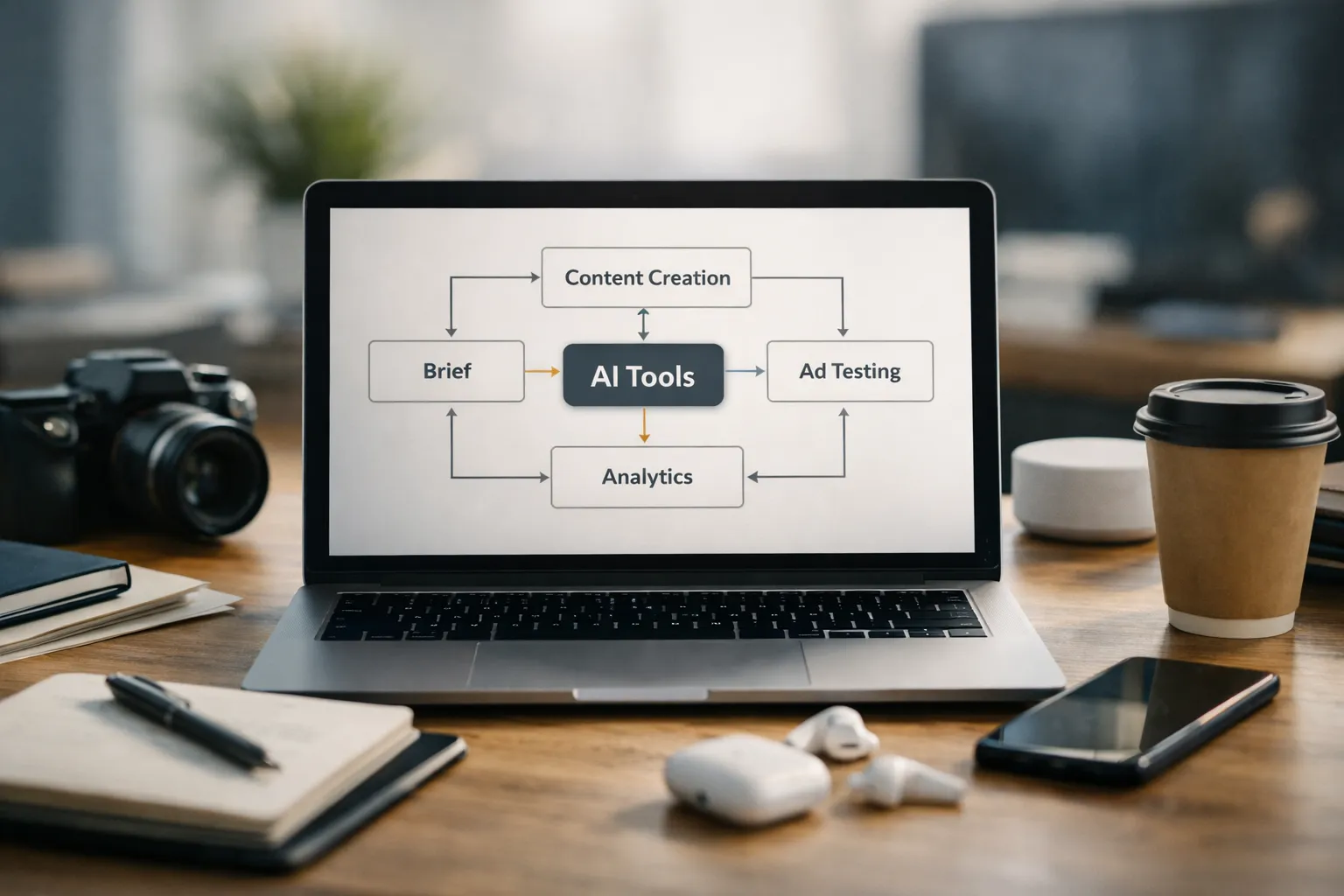
Editorial workflow for AI content creation tools for startup teams
A simple editorial workflow keeps AI content from becoming a pile of disconnected drafts. Picture a kitchen line: prep happens fast, but the head chef still tastes everything.
Start with a brief that includes the audience, the job to be done, one key proof point, and one “red line” (a claim you won’t make without evidence). Then ask the model for three outlines with different angles. Pick one outline and request a draft that includes placeholders for proof, screenshots, or customer quotes.
Then do the human pass-and make it a real pass, not just “tidy up the wording.” Add concrete examples from your product, turn vague claims into measurable ones, and delete anything that sounds like generic advice you could find in ten other blog posts. This is where startups actually differentiate.
A quick litmus test: if your competitor could publish the same paragraph without changing a single word, it’s not done yet.
Finally, produce two versions: a “distribution cut” (shorter, punchier) and a “reference cut” (more detailed). That one move reduces the weekly grind of rewriting the same idea for email, social, and sales.
Repurposing engine: turning one asset into ten (email, blog, social, video)
Repurposing is where AI tools for startup marketing feel magical-but only if you feed them good ingredients. A weak pillar piece just becomes ten weak pieces, faster. So start with one strong asset: a customer story, a benchmark report, a teardown of a competitor’s onboarding, a founder’s point-of-view memo.
Here’s a practical pattern: write one clear narrative, then ask AI to produce an email teaser that drives to the full story, three social posts with different hooks, a short script for a founder video, and a sales enablement blurb your SDR can paste into outreach. The output will be uneven. That’s normal. You’re not looking for perfection-you’re building a “variation pool” you can edit quickly.
A micro-story that shows why this matters: a two-person B2B startup I worked with published one technical deep dive per month. Solid writing, zero time to distribute it. They used AI to turn each deep dive into a weekly email and a rotating set of LinkedIn posts. Without increasing writing hours, they went from one content touch per month to five. Demo requests from social stayed modest, but their sales cycle shortened because prospects arrived better educated.
And that’s a KPI many teams miss: sometimes the win isn’t more clicks. It’s fewer objections.
AI ad optimization software for early-stage startups: targeting, bidding, and creative testing
Ads are expensive tuition. AI can lower the cost of learning by helping you test faster, spot patterns earlier, and cut down the manual busywork. But you still need a plan. Otherwise, automated systems will optimize toward the easiest conversions-not the right customers.
When choosing AI marketing platforms for startups for paid media, prioritize tools that do two things: improve creative iteration and protect measurement. Because if you can’t trust your conversion signals, smart bidding becomes smart guesswork.
Ever had a week where performance “jumps” and you feel like a genius-only to realize you were double-counting conversions? That’s why measurement comes first.
AI ad optimization software for early-stage startups: a 30-day testing roadmap
Use the first month to build signal quality and creative momentum. Keep it boring and structured, because boring is how you get interpretable results.
- Days 1 to 3: Measurement sanity check. Confirm events fire once, values are correct, and UTMs are consistent. If you’re on web, validate in Google Analytics and your ad platform.
- Days 4 to 7: Baseline campaign. Run one campaign with one objective and one primary conversion. Avoid mixing audiences and goals.
- Week 2: Creative sprint. Generate 10 to 20 variations of headlines, primary text, and hooks. Keep the offer constant so you’re testing messaging, not price.
- Week 3: Audience and placement learnings. Let platforms explore, but segment reporting so you can see where performance comes from.
- Week 4: Double down and document. Promote the top 2 to 3 creatives, pause losers, and write a one page “what we learned” memo. Your future self will thank you.
If you want one practical upgrade during this month, connect server-side tracking where possible. Meta’s guidance on the Conversions API is a good starting point.
Using AI to generate and score ad creatives without blowing the budget
The fastest way to waste budget is to test too many variables at once. Let AI generate breadth, then use a human scoring rubric to decide what actually goes live.
A lightweight rubric works best when it’s blunt and specific. For each creative, ask: is it crystal clear who it’s for? Does it name a real pain point (not a fluffy benefit)? Does it include a specific proof point or mechanism? Does it match the landing page promise? Score each from 1 to 5 and only launch the ones that clear your threshold. That one habit keeps your ad account from turning into a graveyard of “technically different” but strategically identical variations.
For execution, most startups can get far with built-in features from platforms like Google Ads and Meta for Business, plus creative tooling like Canva and copy generation in Jasper. You don’t need a sprawling toolchain until you’re spending heavily-and even then, clean fundamentals beat fancy dashboards.
Here’s the human reality: the best model can’t fix a weak offer. If your landing page is unclear, AI will happily optimize you into the wrong lesson.

How startups integrate AI across content, ads, and analytics: analytics platforms and automation workflows
Tools become a system when they share context. Without integration, AI outputs stay shallow because they don’t know what drove revenue, which segment retained, or which message caused refunds. Integration doesn’t have to mean a giant data warehouse on day one. It means consistent identifiers, clean events, and a couple of reliable pipelines.
This is where the Best AI marketing tools for startups stop being “apps” and start becoming an operating model. The guiding question is simple: can you trace an idea from content to click to customer to retention?
AI marketing analytics platforms for startups: attribution, cohorts, and forecasting
For early-stage teams, analytics should answer three questions: where did users come from, what did they do, and who stayed. Attribution helps, but only if you treat it as directional. Even large companies debate attribution models, and Google’s overview of data-driven attribution is a useful reminder that models reflect assumptions.
Many teams start with Google Analytics for acquisition and web behavior, then add a product analytics tool like Mixpanel or Amplitude when activation and retention become the focus. For B2B, tying marketing to pipeline usually means getting serious about your CRM, such as HubSpot or Salesforce.
Forecasting is where AI can be genuinely useful, especially when data is noisy (which, early on, it almost always is). The goal isn’t to predict the future perfectly. It’s to plan ranges: “If trials continue at this rate and activation holds, we can expect between X and Y upgrades.” That turns arguments into scenarios and gives you a calmer way to make decisions.
To make integration concrete, here is a simple mapping of data flows that works well for an AI marketing stack for startups.
| Layer | What you track | Typical tools | What AI can do with it |
|---|---|---|---|
| Content | Asset, topic, publish date, CTA | Notion, HubSpot | Suggest next topics based on conversion by theme and persona |
| Ads | Campaign, creative ID, audience, spend | Google Ads, Meta for Business | Detect creative fatigue and recommend new angles to test |
| Web and product events | Signup, activation, key actions | Google Analytics, Mixpanel | Surface cohorts with high retention and identify drop-off points |
| Identity and routing | User IDs, traits, destinations | Segment | Reduce duplicate events and keep naming consistent across tools |
| Reporting | Weekly metrics and narratives | Looker Studio | Auto draft performance summaries that humans validate and edit |
A practical growth lead mindset: “Automate the plumbing, not the promises.”
Startup marketing automation workflows with AI: end-to-end orchestration
Automation should connect triggers to outcomes. A clean example: when someone downloads a guide, you tag the topic, update your CRM, and send a short email sequence tailored to that topic. AI can help write the sequence and suggest tweaks based on replies or engagement, but the underlying workflow is still just logic.
Lean teams usually orchestrate with tools like Zapier or Make. If you need reverse ETL later, Hightouch can sync warehouse audiences into ad platforms and CRMs. The trick is to start small: one workflow per funnel stage, instrument it, then add complexity.
One more real-world note: automation has a “glass ceiling” if your definitions are fuzzy. If “activated user” means one thing in product and another in marketing, your automations will confidently do the wrong thing. So before you add another zap, get the team to agree on lifecycle stages and the events that define them-and if you’re relying on engineers for tracking changes, tools like Cursor AI can make those codebase updates faster and less error-prone.
A real-world example that shows what a “system” can do: lingerie brand Cosabella reported major gains after implementing AI driven personalization with Emarsys, including a 60 percent revenue increase in a short period after shifting toward more automated, behavior based messaging. The headline is big, but the takeaway is simple: personalization works when it’s grounded in behavior and executed consistently-not when it’s a random sprinkle of first names.
FAQ for best ai marketing tools for startups
A few questions come up in almost every founder-and-marketer conversation about AI. The answers are less about trendy features and more about constraints: budget, time, and the messy reality of data.
What is the most affordable ai marketing stack for lean startups?
Affordable usually means “fewer tools with clearer ownership.” If you’re pre product-market fit, you can often cover a lot with a CRM plus email, a design tool, and analytics.
A common low cost baseline looks like this: HubSpot starter tier for CRM and basic automation, Canva for creative, and Google Analytics for measurement. Add a writing assistant like Copy.ai if content is your main channel.
The bigger lever than price is operational cost. If a tool takes two hours a week to keep clean, that’s expensive for a small team.
How do startups integrate ai tools across content, ads, and analytics without breaking data quality?
Start with naming conventions and identities. Pick consistent event names, campaign naming rules, and a single “source of truth” for customer IDs. Then make sure every tool uses the same UTM structure and the same lifecycle stages.
Next, reduce silent duplication. Duplicate events and mismatched IDs are the hidden tax that makes AI recommendations unreliable. Tools like Segment can help centralize event collection, but even without it, you can enforce discipline with a shared spreadsheet and routine audits.
Finally, separate experimentation metrics from reporting metrics. It’s fine for AI to explore proxy metrics during tests, but your core dashboard should stay stable so you can see real progress.
Conclusion and next steps
AI isn’t a marketing strategy. It’s a force multiplier for whatever strategy you already have. If your positioning is sharp and your measurement is reliable, AI driven marketing software for startups can help you publish more, test faster, and learn with less wasted motion.
So what should you do next-today, not “someday”? Pick one bottleneck and solve it end to end. If content is slow, build the brief-to-draft-to-approval workflow. If ads are costly, run a disciplined 30-day testing plan with clean conversion signals. If reporting is chaotic, standardize events and build one dashboard you actually trust.
Keep it simple, keep it connected, and keep humans in the loop where truth and trust are on the line.
Enjoyed this post?
My goal with this blog is to help people to get started with developing wonderful software while doing business and make a living from it.
Subscribe here to get my latest content by email.
I won't send you spam. You can unsubscribe at any time.